Extreme weather has moved from a background consideration to an active variable in energy and infrastructure projects. Heatwaves, windstorms, hail, floods and wildfire already affect construction schedules, grid reliability and asset valuations.
In Europe, wind speeds between February and April 2025 recorded what was likely their largest drop from long-term averages since 1940. Within months, Ørsted lowered its 2025 EBITDA guidance, citing an impact of around DKK 1.2bn from weaker offshore wind speeds. That makes the impact of extreme weather on energy reliability a planning question as much as an operational one.
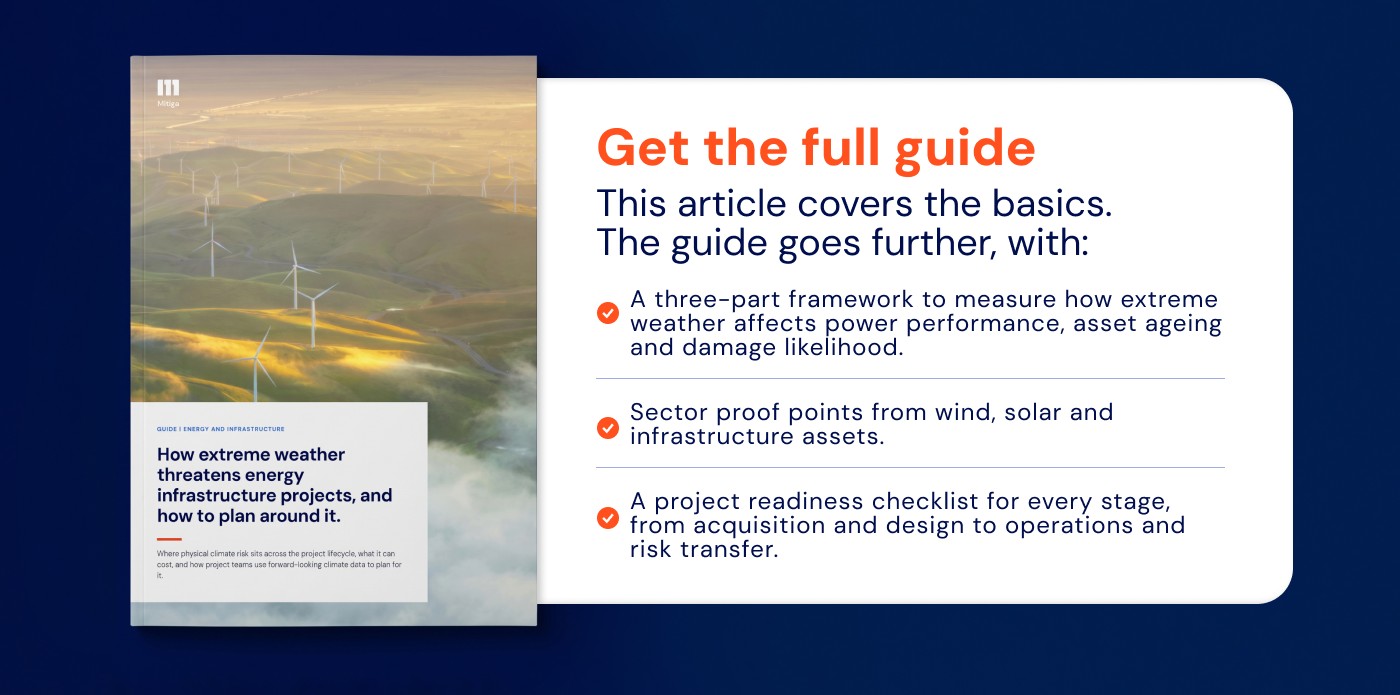
Below is a short overview of where the risk sits. For the full picture, download our guide. It covers each stage in detail, with a planning framework and a project readiness checklist.
Extreme weather doesn't wait for your project to be finished
Construction is often when a project is most exposed. Crane manufacturers set maximum wind speeds for lifting operations, so days above those limits mean stand-downs that can push commissioning back by weeks.
Extreme heat limits safe working hours, and flooding can cut access roads and delay deliveries. Good planning includes weather windows based on site-specific thresholds and emergency plans for energy industry cranes in extreme weather conditions.
Where the grid actually breaks: reliability, storage and congestion
Once assets are live, energy networks at risk from extreme weather events tend to show stress in three places. Heatwaves reduce how much current overhead lines can carry just as demand rises, which can lead to congestion and pressure on voltage profiles. Battery storage can deliver less than expected in sustained heat or cold, often when the grid needs it most. Microgrids can improve resilience, as long as their equipment is specified for the conditions it will face over its working life.
The financial exposure that often goes unpriced
Physical climate risk is moving into the same conversations as transition risk, from investment committees to lender due diligence, and frameworks such as the CSRD and IFRS S2 now require it to be reported. For energy utility companies, it adds a second route to stranded assets: an asset that underperforms or becomes hard to insure can lose value well before the end of its planned life.
When Mitiga Solutions modelled four greenfield 32 MW wind farms in Spain under the RCP 8.5 scenario, climate-related changes in wind resource alone produced a €22m difference in gross returns between the best and worst site over a 25-year hold. Energy finance must account for extreme weather risk, because it moves the same metrics as price, yield and cost.
Why historical weather data isn't enough for siting renewable projects
Historical records describe the climate a site has had. A renewable asset commissioned today will operate in the climate of the 2030s and beyond. Backward-looking averages can understate how hazards are projected to change, and they can mask differences between sites a few kilometres apart and between asset types.
A forward-looking climate risk assessment for renewable energy assets adds site-specific projections, return periods for extreme events and probabilistic outputs that connect to revenue, IRR and capex. That is what the risk management of renewable energy power generation under climate change requires.
We cannot build the infrastructure of the future with the data of the past.
How climate risk software actually gets used by project teams
Climate risk modelling software for utility-scale solar projects, wind portfolios and grid assets is most useful when it feeds decisions teams already make: site selection, due diligence, engineering specifications and investor reporting. Used this way, climate risk analytics for utilities and developers help energy infrastructure projects improve resilience to extreme weather events before the first turbine or panel is installed.
The guide shows how this works in practice, with sector proof points from wind, solar and infrastructure assets.