Climate-related financial disclosure has moved from a voluntary exercise to a core reporting obligation. For companies and financial institutions operating under the International Sustainability Standards Board's (ISSB) framework, understanding IFRS S2 physical climate risk is now a business necessity, not a side project for the sustainability team.
IFRS S2 requiresorganisations to identify which hazards are relevant, assess how those hazards could affect assets and operations, and translate that exposure into financial terms that investors and other stakeholders can act on. This guide sets out what the standard actually requires, and how to build a defensible, data-led process to meet it.
What IFRS S2 asks companies to disclose
IFRS S2 sets out IFRS S2 disclosure requirements across four pillars, closely mirroring the structure established by the TCFD:
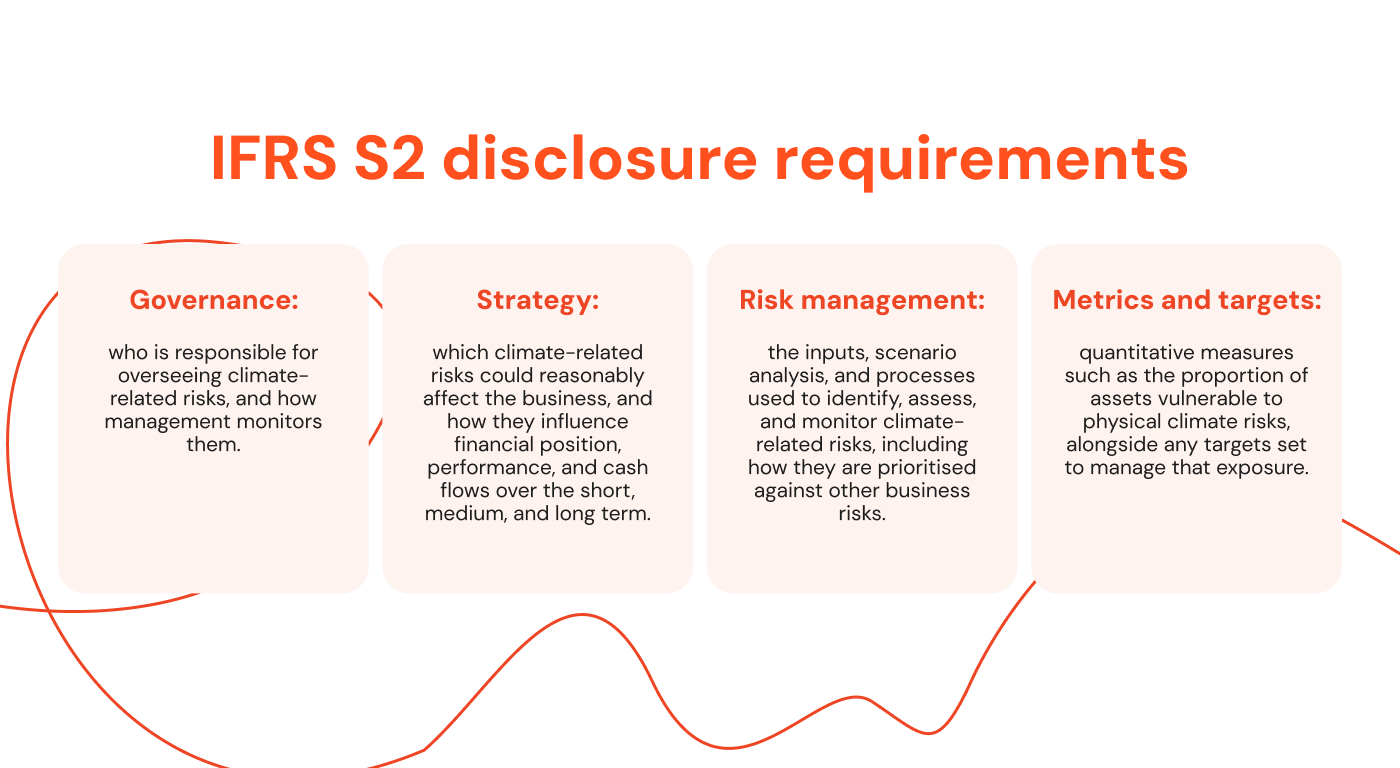
Each pillar is designed to answer one underlying question: does the company understand its exposure well enough to manage it, and can it show its working?
Scenario analysis and the transition from TCFD to IFRS S2
IFRS S2 doesn't start from a blank page. It fully adopts the recommendations of the TCFD, carrying forward the same four pillars and, with them, the expectation that companies use scenario analysis to understand how climate-related risks could play out over time.
The standard expects companies to assess how physical hazards might evolve under different future pathways, typically referencing scenarios aligned with the Intergovernmental Panel on Climate Change (IPCC), and to do so at the level of individual assets rather than a single portfolio-wide estimate.
This is a meaningful step up in technical demand for teams that built their reporting around TCFD's more principles-based approach. Running that kind of asset-by-asset scenario analysis manually, across a portfolio of any size, quickly becomes impractical. It's the part of the process EarthScan is built to automate, applying IPCC-aligned scenarios across every asset in a portfolio rather than requiring a bespoke study for each one.
Understanding and quantifying financial materiality under IFRS S2
A common misconception is that IFRS S2 requires companies to report on every possible climate hazard. It doesn't. The standard is built around IFRS S2 financial materiality: companies are expected to disclose risks and opportunities that could reasonably be expected to affect their cash flows, access to finance, or cost of capital over time.
This means the identification process matters as much as the disclosure itself. A company doesn't need to demonstrate exhaustive hazard coverage. It needs to show a clear, evidence-based method for determining which hazards are relevant to its assets, geographies, and value chain, and why others were screened out. Auditors, investors, and regulators are increasingly asking to see that reasoning, not just the final numbers.
A hazard map showing which assets sit in a flood zone or a wildfire-prone region is a useful starting point, but IFRS S2's financial materiality lens asks for more than a visual overview. The standard expects companies to show the anticipated financial effects of climate-related risks on their position, performance, and cash flows, which means moving from "this asset is exposed" to "this is roughly what that exposure could cost".
This is where Climate Value at Risk (CvAR) becomes relevant. Rather than describing exposure only in qualitative terms, CvAR estimates a potential financial impact per hazard, per scenario, and per time horizon, giving finance and risk teams a figure they can work with alongside more familiar financial metrics. Disclose calculates CvAR for wind and flood hazards specifically, translating hazard-level exposure into monetary terms rather than leaving that conversion to the reporting team.
Quantifying materiality this way also strengthens the underlying screening process. If a hazard's financial impact turns out to be negligible for a given asset, that's a defensible basis for excluding it from detailed disclosure, rather than a judgement call made without supporting data.
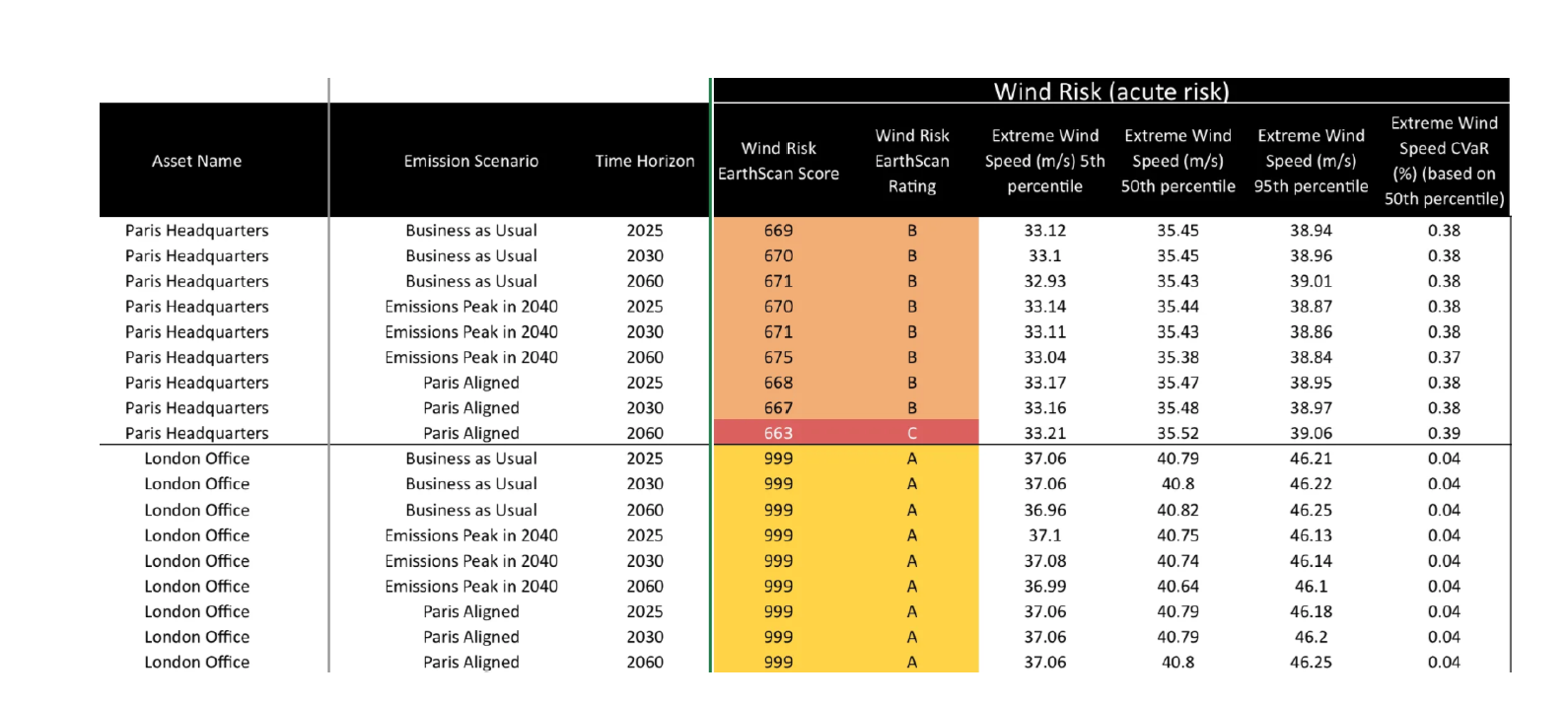
What this looks like in practice: a wind risk output for two illustrative assets might show a Paris-based office scoring a "B" rating under a business-as-usual scenario in 2025, with a CvAR of roughly 0.38%, shifting slightly to a "C" rating and a CvAR of 0.39% by 2060 under a Paris-aligned scenario. A London-based office in the same portfolio might hold an "A" rating across every scenario and time horizon, with CvAR close to 0.04% throughout. The comparison is the point: two offices in the same portfolio can carry meaningfully different exposure, which is exactly why materiality needs to be assessed asset by asset rather than applied uniformly across a portfolio.
How to run a climate risk assessment for IFRS S2
A robust climate risk assessment for IFRS S2 typically follows a consistent path, regardless of sector. The table below sets out the five broad stages of that journey:
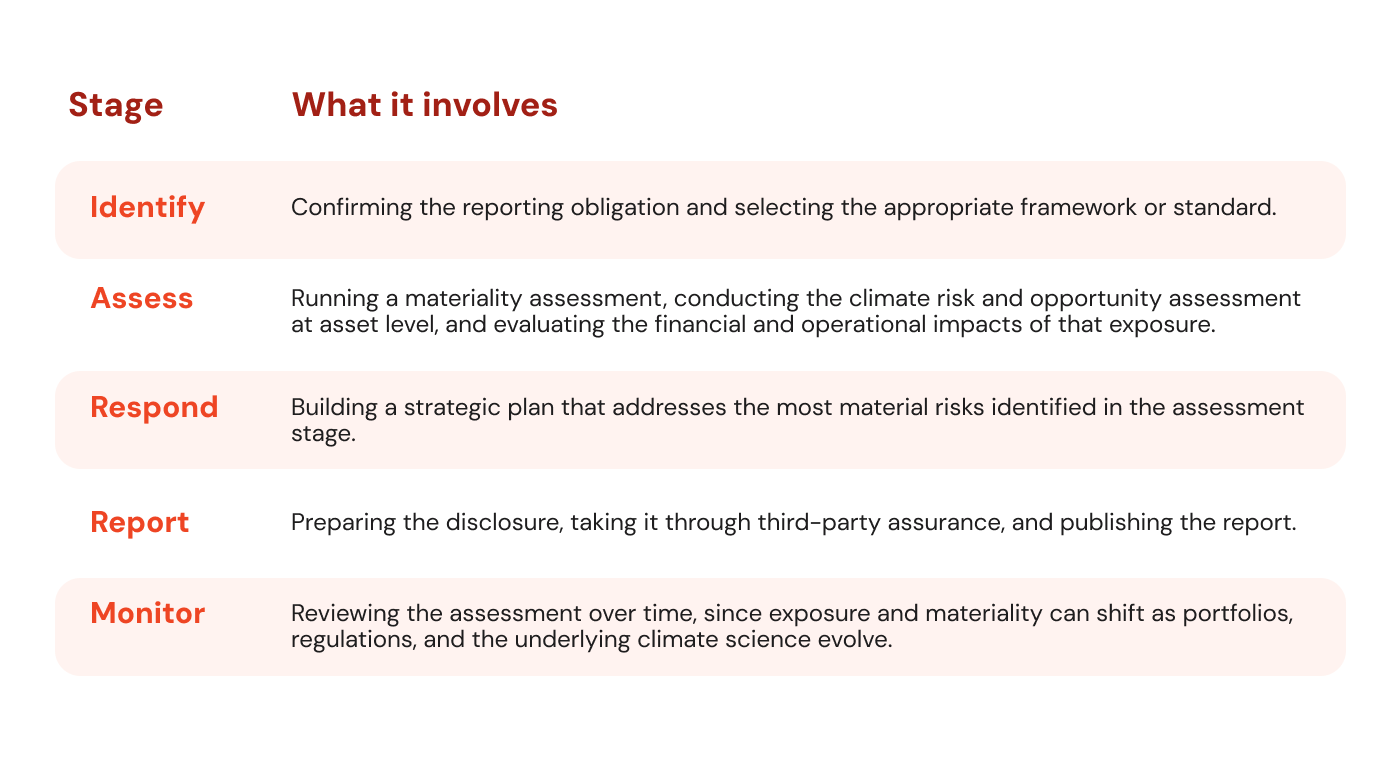
The assess stage is where most of the technical work sits. It requires asset-level geospatial data, multiple emissions scenarios, and time horizons that reflect the expected lifetime of the asset, not a single static snapshot.
Quantifying physical risk: hazards, scenarios, and time horizons
To meet IFRS S2 expectations, companies need to look at both acute and chronic hazards, including flooding, wildfire, drought, heat stress, extreme wind, and precipitation. This is where science-based platforms such as EarthScan support the process directly, providing asset-level insight into these hazards without requiring in-house climate modelling expertise.
A defensible assessment also needs to span multiple futures. EarthScan analyses climate scenarios from business-as-usual through to a Paris-aligned pathway, across continuous data from 1970 to 2100 in five-year increments. This range allows companies to see how their risk profile changes over the short, medium, and long term, exactly the time horizons IFRS S2 asks them to address.
Once hazards are identified and scenarios modelled, the final step is translating exposure into financial terms, such as potential value at risk for a portfolio of assets. This is what turns a hazard map into a disclosure that investors and auditors can actually use.
Asset-level data as the foundation for audit-ready disclosures
Even with the right methodology in place, data collection is often where an IFRS S2 assessment slows down. Gathering coordinates for a global portfolio, matching them against the right hazard models, and keeping that process consistent across regions and asset types is a substantial undertaking when done manually, and harder still to repeat reliably year after year.
A cloud-based platform changes what's practical here. Rather than commissioning a study for each site, a SaaS tool can evaluate thousands of global coordinates in one pass, applying the same scientific methodology consistently across every asset regardless of location. That consistency matters when the output needs to stand up to audit: a reviewer checking one asset's flood exposure should be able to trace the same logic applied to every other asset in the portfolio.
Traceability is the other half of this. Data presented to auditors under IFRS S2 needs to be more than accurate, it needs to be explainable, with a clear line back to the underlying model and scenario used. Structuring outputs this way from the outset, rather than retrofitting documentation after the fact, tends to make the assurance stage considerably smoother.
Where Disclose fits into the process
Disclose, Mitiga Solutions' automated physical climate risk assessment and disclosure tool, is built to support this entire workflow. Built on the EarthScan engine, it quantifies asset-level exposure to acute and chronic hazards across three climate scenarios and three time horizons, then generates outputs mapped directly to IFRS S2, alongside CSRD's ESRS E1 and TCFD.
In practice, this looks like a few concrete outputs a sustainability or risk team can work with directly:
- Quantified exposure per hazard, covering flood, heat, wind, drought, and wildfire at asset level.
- Financial exposure metrics through Climate Value at Risk (CvAR), giving a monetary view of downside exposure for wind and flood hazards across each time horizon.
- Probabilistic return periods across the three scenarios and horizons, rather than a single static figure.
- Excel-based, audit-ready reports, structured so each metric and scenario can be traced back to its underlying model, which matters when third-party assurance reviewers ask how a number was derived.
Disclose also draws on Mitiga's proprietary Signals to flag location-specific hazards that generic or open-source datasets tend to miss, which supports the kind of asset-by-asset reasoning that financial materiality under IFRS S2 calls for. Because the process is automated end to end, it removes much of the manual data preparation that otherwise slows down a first-time disclosure, whether the exposure covers five assets or several thousand.
For teams preparing their first ISSB-aligned disclosure, or refining an existing process, the goal is the same: a screening method that can be explained, defended, and repeated year after year, grounded in data rather than assumption.
What auditors and regulators expect to see
Underneath the specific requirements of IFRS S2 sits a smaller set of expectations that auditors and regulators tend to come back to, regardless of sector or portfolio size:
- Traceability: every figure in a disclosure should be possible to trace back to the model, dataset, and scenario that produced it. A rating or a CvAR estimate that can't be explained on request undermines confidence in the whole assessment, not just that one number.
- Documentation: the reasoning behind which hazards were screened in or out, and why, needs to exist as a written record, not as institutional knowledge held by one team member. This is what turns a materiality assessment from a judgement call into something an auditor can review independently.
- Year-over-year consistency: hazard screening isn't a one-off exercise. A company's exposure can shift as it divests from a region, adds new assets, or as the underlying climate science is updated, so the same methodology needs to be applied consistently each reporting cycle to produce results that are genuinely comparable over time.
Taken together, these three expectations are less about the sophistication of any single model and more about whether the overall process can withstand someone else checking the working.
IFRS S2 doesn't ask companies to model every hazard everywhere. It asks them to know their exposure, explain how they assessed it, and show what it means financially. Getting there requires asset-level data, multiple time horizons, and a consistent, well-documented process, the same building blocks that make any climate disclosure credible under scrutiny.
Not sure which hazards are material to your portfolio? Talk to the Mitiga team about building a defensible, IFRS S2-aligned screening process for your assets.

.png)