For years, assessing physical climate risk followed a predictable, high-level pattern. Organisations relied on broad, regional data or generic real estate models to tick compliance boxes. However, increasing regulatory pressure has been driving a major market shift: global frameworks now mandate a level of granularity that allows businesses to measure precise financial impacts. Generic data is no longer enough to secure corporate budgets or satisfy risk committees.
As a result, businesses now demand asset-specific climate risk analysis tailored to the actual physical characteristics, engineering thresholds, and operational realities of their infrastructure.
Contrasting regional climate data with asset-level reality
When assessing physical risk, treating a solar farm, a deep-water port, and a commercial office block as identical shapes on a map creates dangerous blind spots. Traditional real estate climate models look primarily at postcode-level data or basic building structures, failing to account for how an asset actually works.
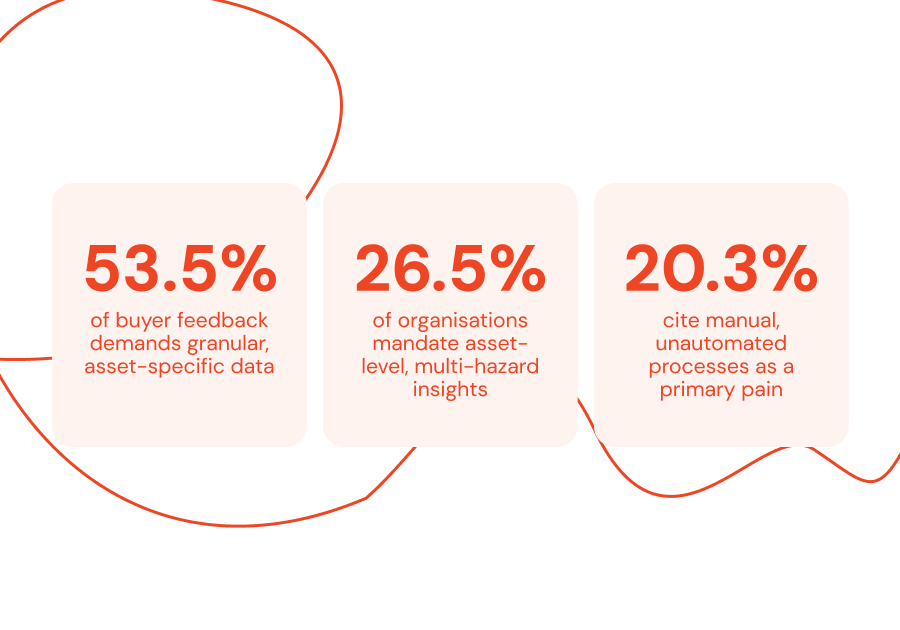
Market evidence highlights this transition. Our industry research shows that 53.5% of product feedback from corporate buyers of climate risk intelligence explicitly demands granular, asset-specific data. Furthermore, 26.5% of organisations now actively mandate asset-level, multi-hazard insights within their resilience frameworks.
Our clients are moving away from these generalised assessments. They want to know exactly how specific climate hazards impact their unique operations. A generic model might indicate that an area faces increased heatwaves, but it cannot tell an infrastructure manager whether that heat will trigger an automatic shutdown of specialised machinery or degrade critical grid components. Adopting an asset-specific climate risk analysis bridges this gap by turning fragmented climate data into clear, decision-ready intelligence.
Why uniform risk frameworks introduce financial error
Different types of infrastructure face completely different risk profiles. Applying a uniform real estate risk framework across diverse asset classes introduces significant financial error. Real-asset investors find that regional resolutions analysis are insufficient.
- Renewable energy plants: Solar and wind installations are highly sensitive to specific atmospheric variables. Generalised models do not account for how hail size impacts solar panel durability, or how shifting wind patterns and extreme heat degrade turbine efficiency and lower long-term energy yield.
- Port terminals: Ports operate at the complex intersection of land and sea. They require deep analysis of sea-level rise, extreme wave actions, and storm surges that directly affect dock operations, crane stability, and maritime supply chains.
- Factories and manufacturing sites: These facilities depend heavily on resource inputs and cooling mechanisms. A factory requires precise data on local water availability and thermal thresholds to prevent costly production halts.
- Logistics hubs: For a logistics centre, the physical building is only part of the equation. Risk analysis must extend to the surrounding transport corridors, assessing how flooding or extreme heat affects road and rail integrity to prevent supply chain failures.
Without this granularity, traditional manual data aggregation becomes slow and resource-intensive. In fact, 20.3% of surveyed organisations state that manual processes and unautomated workflows represent a primary business pain. Traditional data pipelines can require four or five months just to evaluate 20 sites, creating an operational bottleneck for corporate risk teams and the advisory partners supporting them. This is why asset-specific climate risk analysis matters and has become critical for high-value infrastructure.
The math behind the asset: Moving beyond the black box
To address these challenges, Mitiga Solutions builds advanced methodologies that incorporate engineering characteristics and sector-specific vulnerabilities directly into our asset-specific climate risk analysis.
Buyers increasingly reject opaque methodologies. 'Black box' approaches erode corporate trust, while the market actively rewards transparent, scientifically validated methods.Our flagship climate intelligence platform, EarthScan, avoids coarse regional resolutions. Instead, we combine the advanced global climate model (CMIP6) with regional models (CORDEX) and over 40 years of observational data from more than 100,000 stations worldwide.
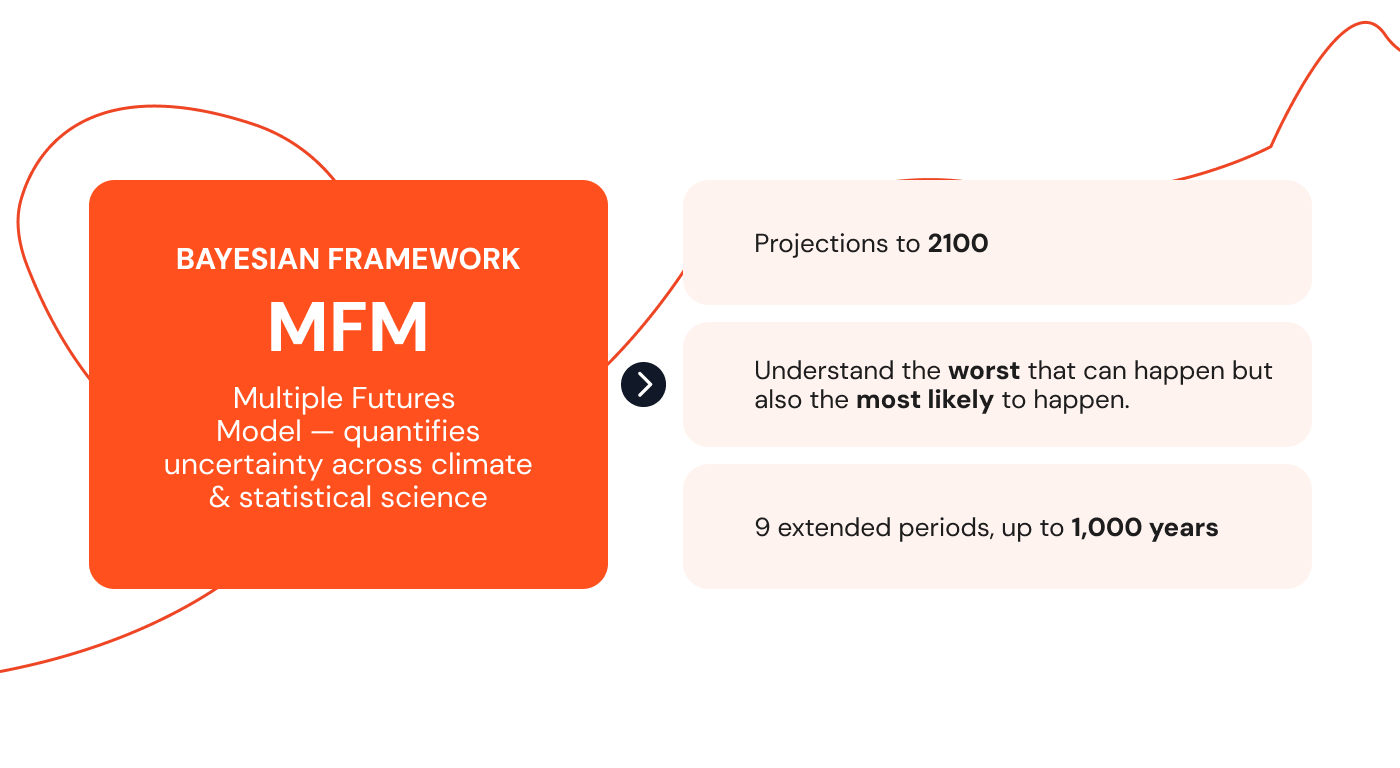
Through our proprietary Bayesian framework, the Multiple Futures Model (MFM), we combine robust climate science with statistical science to quantify uncertainty.
Rather than offering vague, deterministic predictions, this probabilistic foundation allows us to deliver climate-forward looking projections until 2100. We provide return periods for all hazards, spanning standard timelines and nine extended periods up to 1,000 years for high-impact events. This allows engineering teams to test their assets against specific physical thresholds and regulatory requirements.
How asset-level data improves climate risk decision-making
Yesterday's site assessments don't see tomorrow's risks. Once an asset is built or acquired, its exposure is locked in for decades. Site decisions determine structural, financial, and operational outcomes for years to come. To ensure every location decision is future-proof, Mitiga Solutions infuses climate foresight into critical decision points where location and timing matter most:
- Site selection: Evaluate and compare candidate locations based on long-term hazard exposure and structural viability before committing capital.
- Pre-investment and due diligence: Quantify downside risk, future physical climate risk liabilities, and adaptation needs to validate feasibility and pricing assumptions.
- Design and engineering: Turn forward-looking hazard projections into explicit design thresholds and engineering specifications that can withstand future environmental extremes.
- Expansion and repowering: Evaluate whether additional asset capacity or infrastructure expansions remain viable under evolving climate conditions up to 2100.
By embedding this site-level intelligence, organisations can accurately quantify the cost of inaction, estimating potential losses and operational disruptions to make location decisions that stand up to regulators, insurers, and boards alike.
How asset-level risk profiling moves climate from compliance check to strategic lever
Embracing asset-specific climate risk analysis changes how organisations interact with the broader financial ecosystem. European regulatory and reporting mandates drive immediate market demand. Increasingly, organisations require strategic insights to guide capital allocation, prioritizing operational resilience over compliance tick-boxes.
Direct customers and asset owners recognise the clear value of engaging proactively with their internal security and insurance teams. Armed with granular, science-backed risk profiles, companies can demonstrate to underwriters that they understand their specific vulnerabilities and have implemented targeted physical adaptation measures. This transparent approach helps build credibility and supports more accurate insurance pricing.
At the same time, asset managers can help their clients anticipate and implement the specific adaptation measures that insurers are likely to require in the future. By embedding asset-level risk analysis into due diligence and portfolio management, asset managers protect their portfolios from sudden devaluations, satisfy regulatory stress-testing demands, and ensure long-term resilience under a changing climate.